

EXHIBITIONS
Current Exhibitions
May 1 to November 8, 2026
Thick as Thieves
How is an exhibition like a plot? The interrelations between artworks, like the artists who make them and the public who encounter them, yield conspiracies and allyships. Each object can be an agent – a powerful symbol of the various bonds that we nurture or conceal throughout our lives. From an early age we learn that resilience comes from connection, whether with other living beings, to a particular context, or as part of an exclusive network. Thick as Thieves brings together works forged in intense, and often covert forms of connection. Drawn largely from the MacKenzie’s Permanent Collection, this selection of works invites us to consider how themes of fidelity, mutual desire, and fraternity formed by circumstance or power have held the interest of contemporary artists. This exhibition is organized and circulated by The Mackenzie Art Gallery and is curated by Crystal Mowry.


Esmaa Mohamoud, Deeper the Wounded, Deeper the Roots (1), 2019
archival pigment print on paper, edition 1 of 5 (1 AP)
Collection of the MacKenzie Art Gallery. Photo: Don Hall
May 1 to November 8, 2026
When our eyes touch
"When our eyes touch" is an exhibition featuring the portraiture of Peter Whyte and Catharine Robb Whyte. Tracing their careers from early day in art school through the formation of their relationship – and their life-long engagement with community through portrait painting – the exhibition explores themes of intimacy, agency, and subject position. Art school was a formative period for Catharine and Peter as artists, individuals, and partners. In their letters and in Catharine’s diaries, both describe how their ambition to become artists was intrinsically bound to their partnership, and to the encouragement and support they offered one another. Throughout their lives, they continued to paint side-by-side, resulting in multiple pairs of paintings, one by Catharine and one by Peter. Throughout her life Catharine often writes about the experience of making a portrait, whether the sitter holds the pose, how they’ve styled themselves, and instances where the sitter has requested a portrait. This exhibition is interested in portraiture as a shared moment of creation between the artist, the conditions of time and place, and the sitter. From art school to life in Banff and their travels, Catharine and Peter documented the communities around them. They captured their family, friends, acquaintances and each other, collectively leaving a body of work that reflects on their lives as painters. This exhibition is organized by the Whyte and curated by Christina Cuthbertson, Dagny Dubois, Emma De Sousa, and Brittany Staddon.

Through the Lens
Through the Lens began in 1997, founded by The Whyte and led by then-Curator of Photography, Craig Richards. Built on the belief that photography teaches observation, connection to place, and creative discipline, the program gave students across the Bow Valley a rare opportunity to slow down through the practice. Over five months each year, students from Banff Community High School, Canmore Collegiate High School, and Mini Thni Community School learned to operate manual film cameras, develop their negatives and enlarge their prints using traditional darkroom methods. When Craig retired in 2017 the program came to a close, leaving behind multiple generations of young photographers shaped by his teaching and creative encouragement. In 2024 two of those alumni and now photographers, Soloman Chiniquay and Nic Latulippe, returned to the Bow Valley and partnered with The Whyte to bring Through the Lens back to life. With the generous support of the Wim & Nancy Pauw Foundation, they redeveloped the program for students today, expanding the hands-on experience and developing a deeper connection to their work and to the craft. itself. With 50 students taking part this year alone, Through the Lens has now reached close to 700 young photographers across the Bow Valley.

Photo by Sarah Abraham - G10 Canmore Community High School.
Upcoming Exhibitions
Opening November 21st!
I AM
Indigenous Artist Mentorship

I AM: Indigenous Artist Mentorship is an exhibition featuring 13 Indigenous artists spanning nations, generations, and career stages. Each artist has created new work in response to The Ancestors Are Talking, a 2025 exhibition at The Whyte that was curated by Joseph M Sanchez, the last surviving member of the “Indigenous Group of Seven.” For Sanchez, this was an opportunity to help foster the next generation of notable Indigenous artists in Canada. A year-long intensive mentorship program has resulted in I AM, an exhibition exploring a range of subject expressions – from kinship to pop culture, from spirituality to self-representation. Through diverse practices, the artists in this exhibition have declared: I AM… I am here, I am multifaceted, I am the past, present, and future of Canadian art.
This exhibition is organized by the Whyte and curated by emerging Métis curator Emma De Sousa, who embodies a curatorial philosophy rooted in kiyokewin (visiting methodology) and wahkohtowon (kinship and reciprocity praxis).
This exhibition is supported by

Opening November 21st!
Sitting Wind
An exploration of the works of Îethka (Stoney) artist Ganutha Îge (Sitting Wind), also known as Frank Kaquitts (1925- 2002). Paintings from the collection of Peter Whyte and Catharine Robb-Whyte, accompanied by archival materials and audio.
This exhibition is organized by The Whyte and curated by the Hosting Indigenous Community Relations (HICR) team and Curatorial team in collaboration with the Kaquitts family.
.jpg)
Ongoing Exhibitions
Ongoing
Available Year Round
Heritage Gallery
The Heritage Gallery shares Canadian Rockies history through art, artifacts and archives and library materials. This gallery also has information on Indigenous Peoples, surveying, guiding and outfitting, travel, tourism and more!

Previous Exhibitions
November 1, 2025 to April 12, 2026
Elise Rasmussen:
An Alpine Trilogy
"Elise Rasmussen: An Alpine Trilogy" brings together three interconnected bodies of work that resonate deeply in Banff, where mountain culture converges with narratives of conquest, grandeur, and nostalgia. Through rigorous research and lens-based media, Rasmussen recasts traditional narratives of history and nature through an exploration of the French and Swiss Alps. In "Did You Know Blue Had No Name?," she interrogates the symbolism of “blueness,” revisiting Saussure’s cyanometer, the first ascent of Mont Blanc, and early photographic struggles with blue skies. "The Year Without a Summer" links an 1816 climate anomaly to today’s environmental crises, weaving historical texts, folklore, and travel reflections into a meditation on cultural responses to ecological disruption. In "Nostalgia: A Return to the Alps in Five Vignettes," Rasmussen examines the Alps as symbols of healing and escape, from Romantic ideals to modern wellness tourism, questioning our complex longing for harmony with nature. Together, these works reflect on visibility, memory, and the evolving relationship between humans and mountain environments. This exhibition is organized by The Whyte and curated by Christina Cuthbertson.
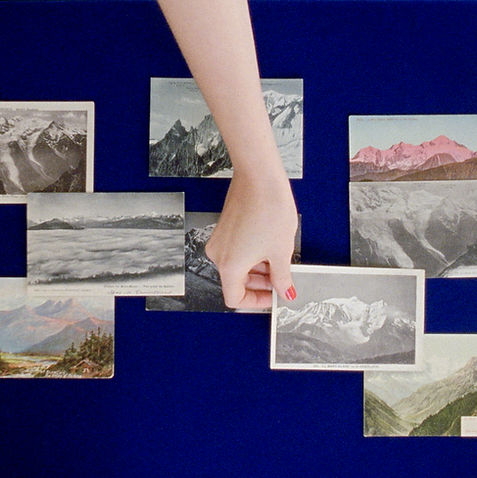
November 1, 2025 to April 12, 2026
Second Take:
Histories of Film in the Rockies
For over a century, the Canadian Rockies have been used as a backdrop for Hollywood adventure epics, melodramas, westerns, and comedies. Whether these movies meant to highlight the Canadian landscape or simply have the scenery stand in for elsewhere, the silver screen influenced how moviegoers see Canada. Drawing from The Whyte Archives & Special Collections, "Second Take: Histories of Film in the Rockies" explores how Canadian identity and stereotypes grew and changed from the silent era to the turn of the century. By highlighting the experiences of the Bow Valley community members involved in select productions, we peek behind the scenes of what it takes to create the fantasy of uninhabited wilderness, lurking enemy danger, stalwart heroes, and damsels in distress. Using titles from the silent era, the summer of 1953, and the late twentieth century, "Second Take" examines how the Canadian Rockies were transformed into the Cypress Hills of Saskatchewan, the wilds of Alaska, and the foothills of Montana by the magic of Hollywood. Local landmarks framed as these far-flung locations changed audiences’ expectations of reality, as well as Canadians’ sense of place. An uncanny duality emerges, one of local pride in seeing the Rockies on the silver screen and the frustration wrought by their inherent misrepresentation. This exhibition illustrates the beauty and ridiculousness of Hollywood’s Canada, elements that linger in our collective imaginations and popular culture to this day. This exhibition is organized by The Whyte and curated by Elizabeth Kundert-Cameron, Dagny Dubois, Kate Riordon, and Brittany Staddon with special mention to Travis Rider and Colleen Crawler.

MAY - OCTOBER 2025
The Ancestors Are Talking
Paintings by the Indigenous Seven

Norval Morrisseau. Attitude and Attention, Punk Rockers. Circa 1991. The Norval Morrisseau Estate, OfficialMorrisseau.com.
JUNE - OCTOBER 2024
J.E.H. MacDonald:
The O'Hara Era
During the summer of 2024, The Whyte offered a rare opportunity to view over 100 works by Group of Seven artist J.E.H. MacDonald from public and private collections. Commemorating the 100th anniversary of his first trip to Lake O'Hara, the exhibition promises to be an exceptional and unique experience, with the Whyte Museum as the sole venue. The show is strengthened by original research conducted by geologists Patricia Cucman and the late Stanley Munn, who meticulously identified the exact locations of MacDonald's works, along with photographs, over the past 18 years. Their findings, documented in a major illustrated book titled To See What He Saw: J.E.H. MacDonald and the O'Hara Years 1924-1932, offer a fresh perspective on MacDonald and his work. Additionally, intriguing discoveries such as paint scrapings and teacup shards have been found in these exact locations, providing further insight into MacDonald's creative process and daily life during his time at Lake O'Hara. Partnering with the Royal Canadian Geographical Society and sponsored by Masters Gallery Calgary, we invite you to join us for this breathtaking exhibition featuring mountain landscapes inspired by MacDonald. J.E.H. MacDonald, R.C.A. (1873-1932, Canadian) Cathedral Mountain from Opabin Pass, 1929, oil on board. Collection of the Whyte Museum of the Canadian Rockies, Gift of Catharine Robb Whyte, O.C., Banff, 1979.
