Lantern Slides
Closed Nov 9–13. Bookstore and Historic Homes tours return Nov 14. Galleries open Nov 21. View November hours.
Open Daily 10 a.m. to 5 p.m.


EXHIBITIONS
Current Exhibitions
Opening November 21st!
I AM
Indigenous Artist Mentorship

I AM: Indigenous Artist Mentorship is an exhibition featuring Indigenous artists spanning nations, generations, and career stages. Each artist has created new work, some in response to The Ancestors Are Talking, a 2025 exhibition at The Whyte that was curated by Joseph M .Sanchez, the last surviving member of the “Indigenous Group of Seven.”
For Sanchez, this was an opportunity to help foster the next generation of notable Indigenous artists in Canada. A year-long intensive mentorship program has resulted in I AM, an exhibition exploring a range of subject expressions – from kinship to pop culture, from spirituality to self-representation. Through diverse practices, the artists in this exhibition have declared: I AM… I am here, I am multifaceted, I am the past, present, and future of Canadian art.
Participating artists are Brandon Atkinson, Cheyenne Bearspaw, Bruno Canadien, Hali Heavy Shield, Kyle Kaquitts, Brendon Many Bears, Nathan Meguinis, Kristy North Peigan, Jarron Poucette, Lillian Rose, Giona Smalleyes, Gordon Wesley and Tiffany Wollman.
This exhibition is organized by The Whyte and curated by emerging Métis curator Emma De Sousa, who embodies a curatorial philosophy rooted in kiyokewin (visiting methodology) and wahkohtowon (kinship and reciprocity praxis).
This exhibition is supported by:

Opening November 21st!
Sitting Wind
Sitting Wind explores the work and legacy of Îethka (Stoney) artist Ganutha Îge (Sitting Wind), also known as Frank Kaquitts. Born in Maskwacis (Hobema), Sitting Wind moved to Mînî Thnî (Morley) as a little boy and rapidly became a strong figure in his community.
He attended the Banff School of Fine Arts, focusing on landscape painting with the support from the Stoney Nation and with the encouragement and mentorship of Peter and Catharine Whyte.
The exhibition invites a reading of Sitting Wind’s artistic career across the visual language of the land, Indigenous way of life, and his later work “Quadravision” which simultaneously layers notions of past, present, and future. We quietly
honour the chapters of his life as a political leader, as a film actor and most importantly as a family man.
Paintings from the collection of Peter Whyte and Catharine Robb Whyte are presented alongside archival materials and audio, offering insight into Sitting Wind’s life, artistic career and enduring relationship with this place.
Sitting Wind is organized by The Whyte and curated by the Hosting Indigenous Community Relations and Curatorial teams in collaboration with the Kaquitts family.

Opening November 21st!
Connection, Community, and the World
Recent Additions to the Collection
Collections are the backbone of a museum. What we collect impacts our exhibitions and programming and shapes the perspectives and experiences that we preserve for future generations. Through donations and purchases The Whyte continues to grow its art, heritage, and archival collections. This exhibition highlights some of the artworks that have been added to the collection in recent years. These works, created from 1939 to 2023, explore themes of identity, community, connection with the natural world, and places of great significance to the artists. The Whyte is grateful for the generous donations that continue to enhance our collections and exhibitions. Artists: Franklin Carmichael Eddy Cobiness David Garneau Martha Isabel Houston Robert J. Hope Carl Ray Clifford Foard Robinson Joseph M. Sanchez Adrian Stimson James Tanner Curated by Amie Lalonde

Opening November 21st!
Nicholas Morant
The Man Behind the Curve
Nicholas “Nick” Morant (1910-1999) was an acclaimed photographer known for his iconic images of life in the Canadian Rockies. Like many early photographers in the Bow Valley, Morant skillfully captured the grandeur of the world around him. Yet, Morant’s images also carefully present an idealized relationship between people, the built environment, and nature. As Special Photographer for the Canadian Pacific Railway – and always assisted by his wife, Ivy “Willie” Morant – he captured a stretch of the CPR line that still bears his name: Morant’s Curve. As a longtime Banff resident, Morant’s photography contributes to a visual narrative that continues to influence our perceptions of Banff as idyllic, harmonious, and majestic. Morant’s mid-century colour photographs often introduce eye-catching human interventions, such as coloured lights on snow, red canoes on a glassy river, or posed figures in rich tones set against dramatic mountain backdrops. Today, his manicured images of iconic Banff National Park locations evoke nostalgia for a quieter time; a time less inundated with photography, when the composed image was more pleasantly believable. This exhibition is curated by Kate Riordon and represents a small sample of the thousands of photographs taken by the Morants that are housed in The Whyte Archives.

Upcoming Exhibitions
Check back for more exhibitions soon!
Ongoing Exhibitions
Ongoing
Available Year Round
Heritage Gallery
The Heritage Gallery shares Canadian Rockies history through art, artifacts and archives and library materials. This gallery also has information on Indigenous Peoples, surveying, guiding and outfitting, travel, tourism and more!

Previous Exhibitions
November 1, 2025 to April 12, 2026
Elise Rasmussen:
An Alpine Trilogy
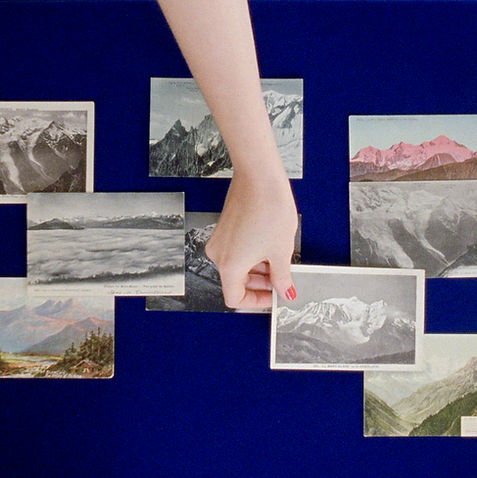
"Elise Rasmussen: An Alpine Trilogy" brings together three interconnected bodies of work that resonate deeply in Banff, where mountain culture converges with narratives of conquest, grandeur, and nostalgia. Through rigorous research and lens-based media, Rasmussen recasts traditional narratives of history and nature through an exploration of the French and Swiss Alps. In "Did You Know Blue Had No Name?," she interrogates the symbolism of “blueness,” revisiting Saussure’s cyanometer, the first ascent of Mont Blanc, and early photographic struggles with blue skies. "The Year Without a Summer" links an 1816 climate anomaly to today’s environmental crises, weaving historical texts, folklore, and travel reflections into a meditation on cultural responses to ecological disruption. In "Nostalgia: A Return to the Alps in Five Vignettes," Rasmussen examines the Alps as symbols of healing and escape, from Romantic ideals to modern wellness tourism, questioning our complex longing for harmony with nature. Together, these works reflect on visibility, memory, and the evolving relationship between humans and mountain environments. This exhibition is organized by The Whyte and curated by Christina Cuthbertson.
November 1, 2025 to April 12, 2026
Second Take:
Histories of Film in the Rockies
For over a century, the Canadian Rockies have been used as a backdrop for Hollywood adventure epics, melodramas, westerns, and comedies. Whether these movies meant to highlight the Canadian landscape or simply have the scenery stand in for elsewhere, the silver screen influenced how moviegoers see Canada. Drawing from The Whyte Archives & Special Collections, "Second Take: Histories of Film in the Rockies" explores how Canadian identity and stereotypes grew and changed from the silent era to the turn of the century. By highlighting the experiences of the Bow Valley community members involved in select productions, we peek behind the scenes of what it takes to create the fantasy of uninhabited wilderness, lurking enemy danger, stalwart heroes, and damsels in distress. Using titles from the silent era, the summer of 1953, and the late twentieth century, "Second Take" examines how the Canadian Rockies were transformed into the Cypress Hills of Saskatchewan, the wilds of Alaska, and the foothills of Montana by the magic of Hollywood. Local landmarks framed as these far-flung locations changed audiences’ expectations of reality, as well as Canadians’ sense of place. An uncanny duality emerges, one of local pride in seeing the Rockies on the silver screen and the frustration wrought by their inherent misrepresentation. This exhibition illustrates the beauty and ridiculousness of Hollywood’s Canada, elements that linger in our collective imaginations and popular culture to this day. This exhibition is organized by The Whyte and curated by Elizabeth Kundert-Cameron, Dagny Dubois, Kate Riordon, and Brittany Staddon with special mention to Travis Rider and Colleen Crawler.

MAY - OCTOBER 2025
The Ancestors Are Talking
Paintings by the Indigenous Seven

Norval Morrisseau. Attitude and Attention, Punk Rockers. Circa 1991. The Norval Morrisseau Estate, OfficialMorrisseau.com.
JUNE - OCTOBER 2024
J.E.H. MacDonald:
The O'Hara Era
During the summer of 2024, The Whyte offered a rare opportunity to view over 100 works by Group of Seven artist J.E.H. MacDonald from public and private collections. Commemorating the 100th anniversary of his first trip to Lake O'Hara, the exhibition promises to be an exceptional and unique experience, with the Whyte Museum as the sole venue. The show is strengthened by original research conducted by geologists Patricia Cucman and the late Stanley Munn, who meticulously identified the exact locations of MacDonald's works, along with photographs, over the past 18 years. Their findings, documented in a major illustrated book titled To See What He Saw: J.E.H. MacDonald and the O'Hara Years 1924-1932, offer a fresh perspective on MacDonald and his work. Additionally, intriguing discoveries such as paint scrapings and teacup shards have been found in these exact locations, providing further insight into MacDonald's creative process and daily life during his time at Lake O'Hara. Partnering with the Royal Canadian Geographical Society and sponsored by Masters Gallery Calgary, we invite you to join us for this breathtaking exhibition featuring mountain landscapes inspired by MacDonald. J.E.H. MacDonald, R.C.A. (1873-1932, Canadian) Cathedral Mountain from Opabin Pass, 1929, oil on board. Collection of the Whyte Museum of the Canadian Rockies, Gift of Catharine Robb Whyte, O.C., Banff, 1979.
