
A Century of Photographs from the Luxton Family Collection
Updated: Feb 23
By Brittany Staddon, Digital and Photograph Preservation Technician
As I assessed the condition and digitized 120 framed photographs from the Luxton family fonds, it was evident how what we choose to frame and place on our walls reflects our priorities and interests. The Luxton Family photograph collection spans a century, from 1860 to 1960, and was carefully assembled by Norman and Georgina Luxton and their daughter Eleanor, offering a visual record of family, place, and photographic craft across generations.
The oldest photographs are studio portraits from Georgina’s family, many set in elaborate frames that denote the special occasion of having a portrait taken during the late 19th century. One of my favourite projects was returning a portrait of Georgiana McDougall (1851-1870), Georgina Luxton’s paternal aunt, to its original frame, one of the most elaborate in the collection. The frame is in the Eastlake style, with ebonized wood with carved floral patterns in the corners. The oval-cut mat has carefully applied drawn golden detailing, framing the albumen print, which has been retouched to add detail to the subject’s hair and brooch. (Figure 1)

In contrast to the refined Eastlake frame style, was that of the tramp art style, in which what would commonly be considered waste materials were used to construct practical objects - in this case, two matching frames for two unidentified people. Similarly elevated by an oval mat with hand-applied gold detailing. (Figure 2 and 3)


In a rather unremarkable wooden frame from the same period is a photograph of Reverend George McDougall. On first glance, it’s a simple studio portrait - but on further inspection, it becomes apparent how meticulous J.G. Parks photography studio in Montreal was in realizing a portrait that suited the sitter’s expectations. The photograph is a composite - the background was changed after the photograph was taken. Reverend McDougall and the chair he is sitting in have been cut from the original portrait, placed on a photograph of a painted library backdrop, and the two scenes are blended in dark ink, which is likely more apparent now due to the photograph's fading. Next time you look at a late-19th-century studio portrait, check for signs of retouching! (Figure 4)

Moving into the 20th century, the photographs primarily reflect businessman Norman Luxton’s interests: local wildlife, mountain scenery, the Tilikum, and portraits of his dogs, Barney and Larry. (Figures 5 and 6)


I was particularly intrigued by a series of ten panoramic photographs taken by the Detroit Photographic Company in 1902. Taken on 8x10 glass negatives and carefully printed, these images capture popular views of the Canadian Rockies to be sold as prints and postcards to local visitors and people abroad. One of the smallest panoramas in the collection, composed of only two negatives, shows a much quainter Banff from the top of Tunnel Mountain. On the south side of the Bow River, you can view the Banff Sanitarium overlooking only a handful of houses and storefronts present at the turn of the century. (Figure 7) Another frames the Bow Valley towards Mount Rundle, showing some of the original wooden structure of the Banff Springs Hotel (Figure 8). The largest panorama, nearly 3.5 feet wide, depicts the Selkirk Mountains from Mount Abbott, which surely would not have been an easy feat to climb in 1902 with the glass negatives and large camera! (Figure 9) Taken the same year Norman Luxton first arrived in Banff to recuperate from his Pacific voyage, these panoramas act as a timepiece of the area when he first called the area home.


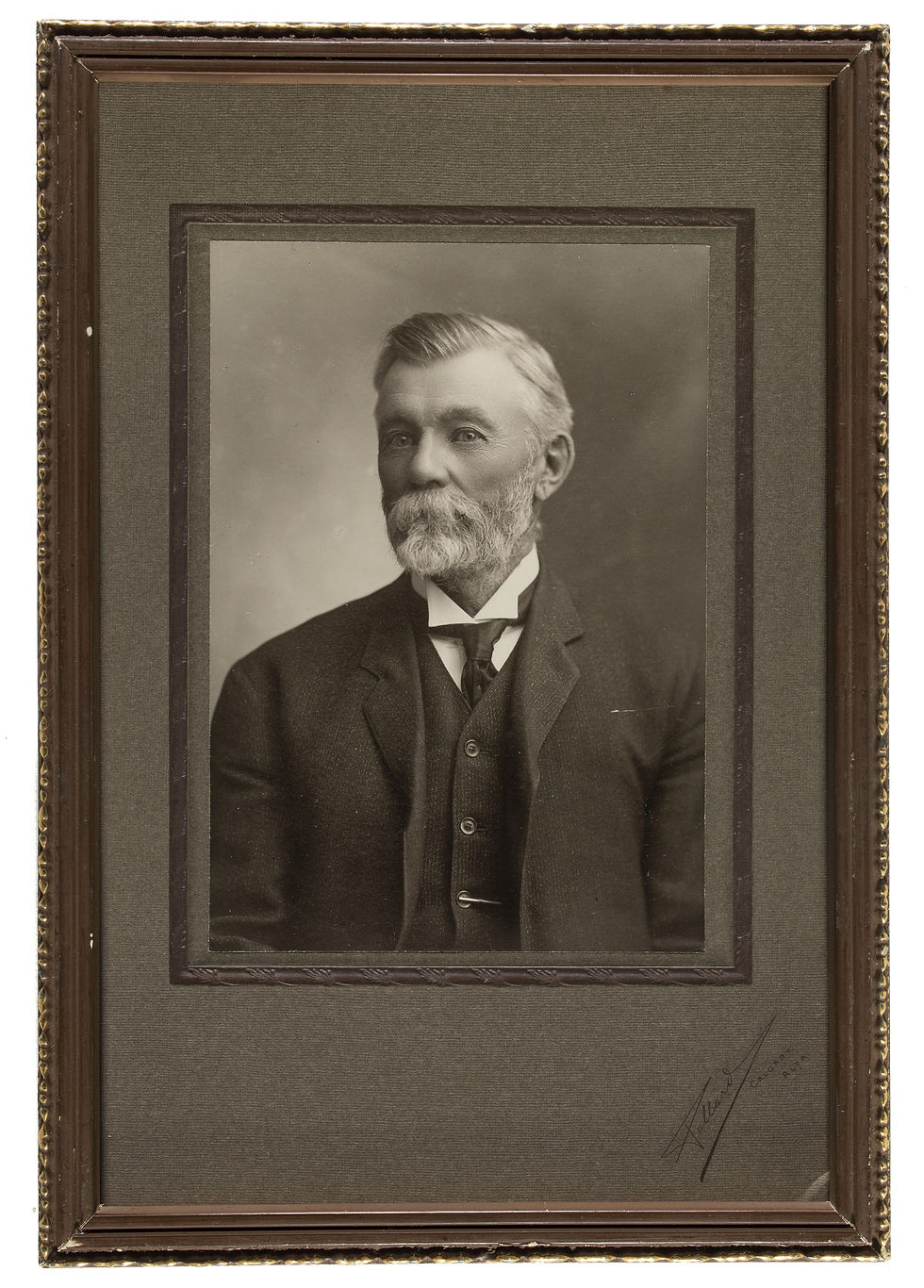
Eleanor’s framed collection reflects her personal life - depicting her friends and family. As one always intrigued by process, I was interested in a photographic portrait of David Nawash McDougall, Eleanor’s maternal grandfather (Figure 10), when compared to a photomechanical print (Figure 11) likely made by referencing the portrait taken by Harry Pollard. The engraver turned David’s shoulders, straightened his tie, and trimmed his beard - providing a more refined portrait. What differences and similarities can you spot?

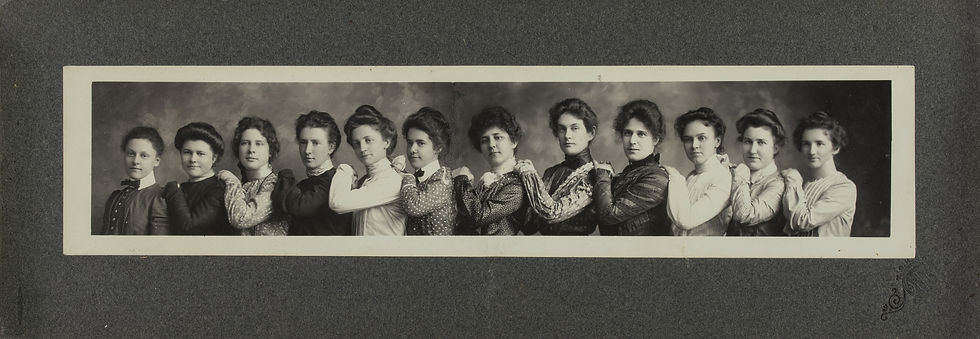
Lastly, a favourite of the Archives is a studio portrait of May McDougall, Eleanor’s maternal aunt, and eleven friends. They are standing in a row, arm propped on their neighbour's shoulder, forming a rather uncanny scene compared with what we might generally be accustomed to in early 20th-century portraiture. (Figure 12)
Be sure to access the newly digitized frames from the Luxton family fonds and other materials in the collection through The Whyte’s online database or by appointment by contacting archives@whyte.org. Additional information regarding the Luxton family may be accessed on the Eleanor Luxton Historical Foundation’s website.
Interested in learning more about Canadian Rockies history? Book a research appointment at the Archives and Special Collections Library at The Whyte. Archives and Special Collections appointments are available Tuesday – Friday, 1:00 p.m. to 5:00 p.m. To make an appointment or for inquiries email: archives@whyte.org
For more information on visiting The Whyte, visit us online at whyte.org/visit. The museum is open daily from 10 a.m. to 5 p.m.
Image Descriptions:
Figure 1: [Georgiana Luxton], [between 1867-1870], Luxton family fonds, LUX / III / D / PC - 6
Figure 2: [Portrait of unidentified man], [between 1860-1880], Luxton family fonds, LUX / III / D / PC - 4
Figure 3: [Portrait of unidentified woman], [between 1860-1880], Luxton family fonds, LUX / III / D / PC - 5
Figure 4: [Unidentified man, possibly Reverend George McDougall], [between 1865-1880], Luxton family fonds, LUX / III / D / PC - 80
Figure 5: [Tilikum with seven people in Victoria, B.C.], 1902, Luxton family fonds, LUX / III / D / PC - 50
Figure 6: [Larry and Barney O'Toole], [between 1930-1950], Luxton family fonds, LUX / III / D / PC - 83
Figure 7: Detroit Photographic Company, 01455. Up Bow Valley from Tunnel Mountain, Alberta., 1902, Luxton family fonds, LUX / III / D / PC - 92
Figure 8: Detroit Photographic Company, 01065. Down Bow Valley from Banff Springs Hotel, Alberta., 1902, Luxton family fonds, LUX / III / D / PC - 45
Figure 9: Detroit Photographic Company, 010681. The Selkirks from Mt. Abbot, 014646. Sir Donald from Mt Abbot, Selkirk Mountains, B.C., 1902, Luxton family fonds, LUX / III / D / PC - 96
Figure 10: Harry Pollard, [David Nawash McDougall portrait], [between 1900-1910], Luxton family fonds, LUX / II / F / PC - 11
Figure 11: [David Nawash McDougall portrait], [between 1900-1910], Luxton family fonds, LUX / II / F / PC - 1
Figure 12: [Panorama portrait, May McDougall and friends], [ca. 1905], Luxton family fonds, LUX / II / F / PC - 23


Comments