
Building the Exhibition: Peter and Catharine Whyte, Assiniboine Camp 1937
Updated: Feb 23
By Amie Lalonde, Registrar and Assistant Curator
As we prepared for our winter exhibitions, we knew we wanted to put up a wall of Peter and Catharine’s art to stay connected to our roots. Having hung many a “P&C” exhibit before, I knew I wanted to take a somewhat different look at some of their art.
Peter Whyte’s Mount Assiniboine in September Snow has always been one of my favourite paintings of his, and while looking through the catalogue of their work, I realized that there were many more paintings from Assiniboine in 1937 than I had realized. The exhibit includes 15 of the 17 oil sketches that remain in our collection from that trip. A further three studio works were completed by Peter sometime after returning home from the backcountry. As a big fan of Mount Assiniboine, I immediately saw potential for an exhibition focused on this trip - shaped into what is now presented as Peter and Catharine Whyte Assiniboine Camp 1937.

I went to our online database to take a look at Catharine Whyte’s letters to her mother, which were digitized in 2021. I found that Catharine had written a short letter to her mother on September 15, telling her they were leaving for Assiniboine the next day. She wrote another short letter on September 19 and longer letters on the 22nd and 30th, in which she discussed the camp, painting, and the weather in great detail. After returning to Banff, she wrote another long letter on October 5, chronicling the snowy journey home.
One of my favourite aspects of these letters was reading Catharine’s description of several scenes that she and Peter painted. My favourite example of this is in her September 22nd letter, where she described how the yellow larches looked under a blanket of fresh snow:

“It really is lovely the trees so bowed down with snow as there has been no wind. Its light snow too. The larch trees lost lots of branches as their needles are still on. But pretty where you can see them yellow under the snow. It gives quite an idea of how it would look in winter.”
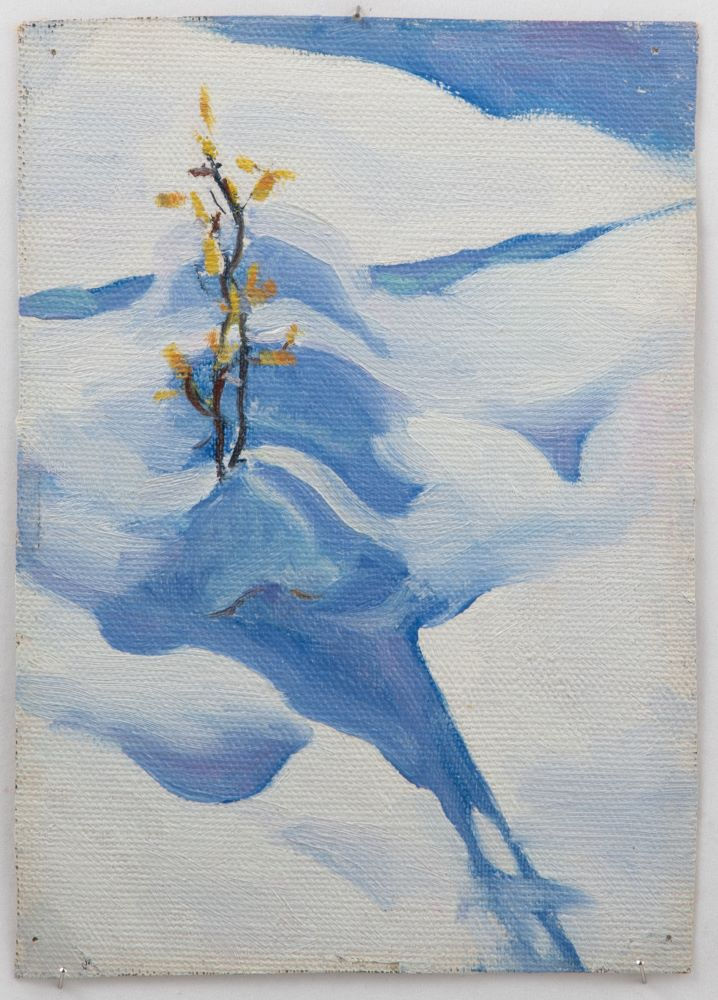

Both Peter and Catharine deftly captured this in their own styles: Catharine focusing on a single larch against bright snow (likely during a break in the storm), and Peter’s dark, more abstract representation that looks as if it were painted in the thick of the snowstorm.
By arranging the art in a rough chronological order, I hoped viewers would experience the Assiniboine trip as Peter and Catharine did – from the bright, sunny autumn days, the drama of the oncoming storm, and finally, the landscape blanketed in white.
On our online database, I also came across photographs that Peter took during that trip, which I had never seen before. These photographs were special because Peter had written descriptions on the backs, something he did not often do. Between the paintings, Catharine’s letters, and these photographs, I knew this would make a compelling mini-exhibition.
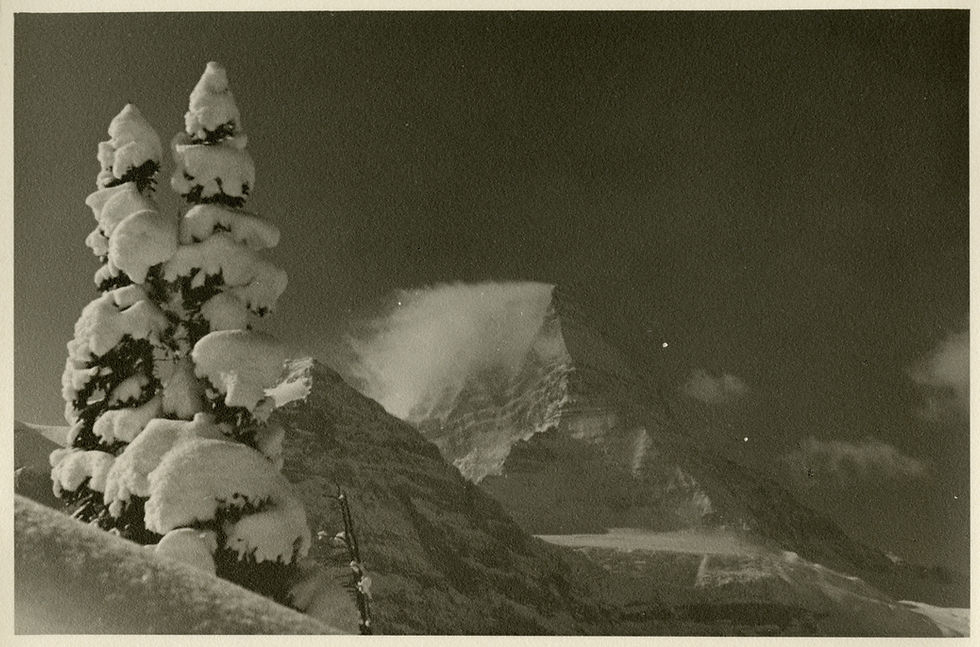

The bulk of Peter’s photographs were from the return trip to Banff, and along with Catharine’s October 5th letter, we have a pretty comprehensive picture of the journey. One of the highlights for me was Catharine describing how Yuk Soy Goon, aka “Sunshine”, who was the cook at Erling Stom’s Assiniboine camp, was bundled up against the storm in “… high heeled boots of Chucks. Old tweed plus-fours of Erlings, someone’s checkered woolen shirt + his own sweater, a cap, over which he tied a pink-bordered bath towel fastened with a safety pin under his chin + over everything trailing behind a bright yellow slicker. He had to loop this over his arm like a train when he walked.” Pairing this description with Peter’s photograph, we can imagine exactly what his outfit looked like – and with a little help from Photoshop, we can almost see it – reminding us that the past was actually just as colourful as today.

Peter’s photographs and note on going up Brewster Pass give us an idea of the conditions that the group faced on their two-day journey out.


Catharine’s account expands further; she tells her mother that:
“It was nearly four when we ate our sandwiches and had a little tea at the foot of Brewster Pass, and then it began snowing hard as we slowly climbed up to the tree line and above on Brewster. We went through a whole flock of Ptarmigan, already turning white. It snowed harder all the whole and as we got above the trees it was harder to see as everything was white. The snow on the ground was deeper and deeper & on us too. Finally we had to get off the horses and walk. It was more floundering as the snow had drifted and was nearly two feet deep. Poor Sunshine with his trailing slicker was having a hard time of it. His first time on a horse was on the way out to Assiniboine and this was his second time only….”
“the snow was three feet deep in most places near the top and the horses floundered up to their bellies in the drifts…”
“The side hill was rather uncomfortable as the edge was soft and the horses hind legs would often slip down over the edge in rather an alarming way. In fact they all slipped and stumbled a bit which gave rather an uncertain feeling. Especially as one of the girls who was out there had her horse fall with her. She tried to get off and the horse got scared and started to run and her foot caught in the stirrup and she was dragged quite a way… but luckily was none the worse for it. However I couldn’t help but wonder what I would do if my horse fell.”
It’s rare to get such a full picture of a painting trip that took place nearly a century ago. I think many artists will be able to relate to Catharine’s accounts of painting such variable weather and capturing such a vast landscape. Many locals will also relate to Peter’s glee at such a big snowfall following a disappointing winter.
I encourage everyone to read Catharine’s letters in full; if you can decipher her handwriting, they are truly a valuable resource into life in Banff nearly 100 years ago.
Come to the museum to see the exhibit in full and take your own mini trip to Mount Assiniboine!
Plan your visit today, wander the galleries, and take your own small expedition to Assiniboine.
Visit us at 111 Bear Street, Banff, Alberta - open daily from 10 a.m. to 5 p.m.


Comments