
When our eyes touch: Behind the Scenes of an Exhibition in the Making
Updated: Jul 8
By Christina Cuthbertson, Chief Operating Officer and Curator
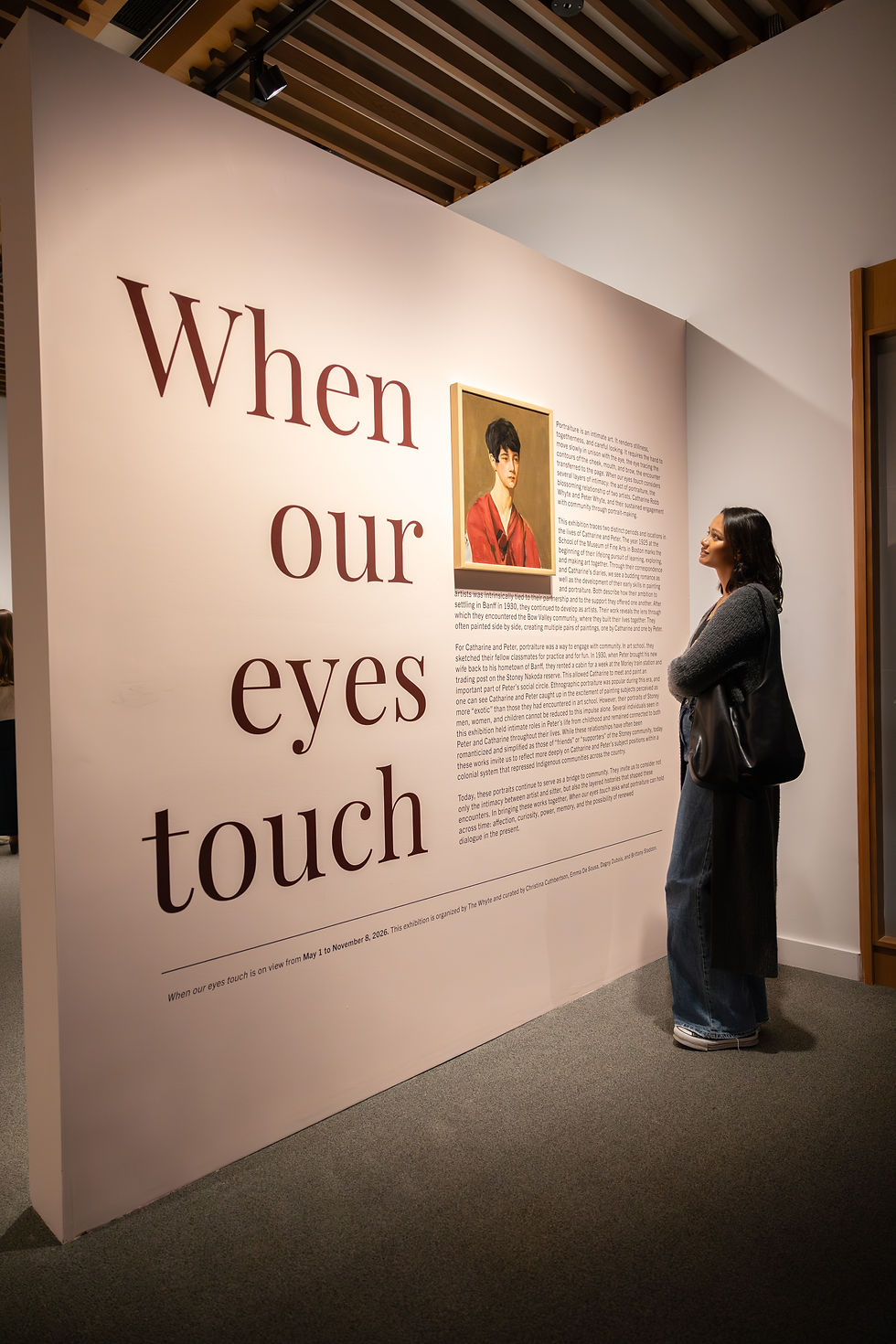
When I arrived at The Whyte, I was captivated by the story of Catharine and Peter Whyte. Like many before me, I began to follow the plot: their art school romance in Boston, Catharine’s gutsy move to Banff, the couple’s friendships with the Stoney people, and Peter’s tragic battle with alcoholism. Their story has all the contours of a Hollywood movie, and there is a Hollywood movie based on their lives. While it may be enticing to think of their lives in these terms – as a story, narrative, or drama, served up for entertainment and easy consumption – the reality of their lives and legacy is much more interesting and nuanced.
How It Began
In early 2026, when we set out to develop an exhibition of Catharine and Peter’s art, we wanted to understand that nuance through an exploration of intimacy, community, and subject position inherent in their portraiture. The result was When our eyes touch, an exhibition that considers several layers of intimacy: the act of portraiture, the blossoming relationship of two artists, Catharine Robb Whyte and Peter Whyte, and their sustained engagement with community through portrait-making.
The When our eyes touch exhibition begins with five drawings by Peter Whyte from the late 1920s that seem to depict his fellow classmate, Catharine Robb, whom he would later marry. It is tempting to cast our imaginations into the setting; one can feel Peter’s gaze on Catharine’s jawline or the bottom curvature of her lip. While portraiture is not always charged with romantic intensity, these drawings offer a glimpse into the self-awareness, relationality, and agency of both the artist and the sitter in their shared moment of creation.

The title of the exhibition comes from Jacques Derrida, who asks in the opening lines of On Touching, “When our eyes touch, is it day or is it night?” Eye contact is an evocative thing. It can be coded romantically or politically and shaped by power dynamics. It can be furtive, sustained, cautionary, or inviting. For us, this phrase offered a way not only to think about what happens in a portrait sitting, but also what happens when we look back at historical subjects from the present. What do we see? What do we miss? What can we know? And what do we inherit?
Understanding Catharine and Peter Through the Archives and Collections
The exhibition team included Emma De Sousa, who supported community engagement and curatorial direction; Brittany Staddon, who led archives research and supported exhibition design; Dagny Dubois, who has the most extensive knowledge of the subject and oversaw all aspects of exhibition development; and me, who was newest to the story of Catharine and Peter’s lives and held the position of creative lead on the project. From the beginning, our conversations were shaped by a desire to look closely and carefully. We wanted to honour Catharine and Peter as important community builders and artists, while allowing their humanity to shine through the mythology that has developed around them.
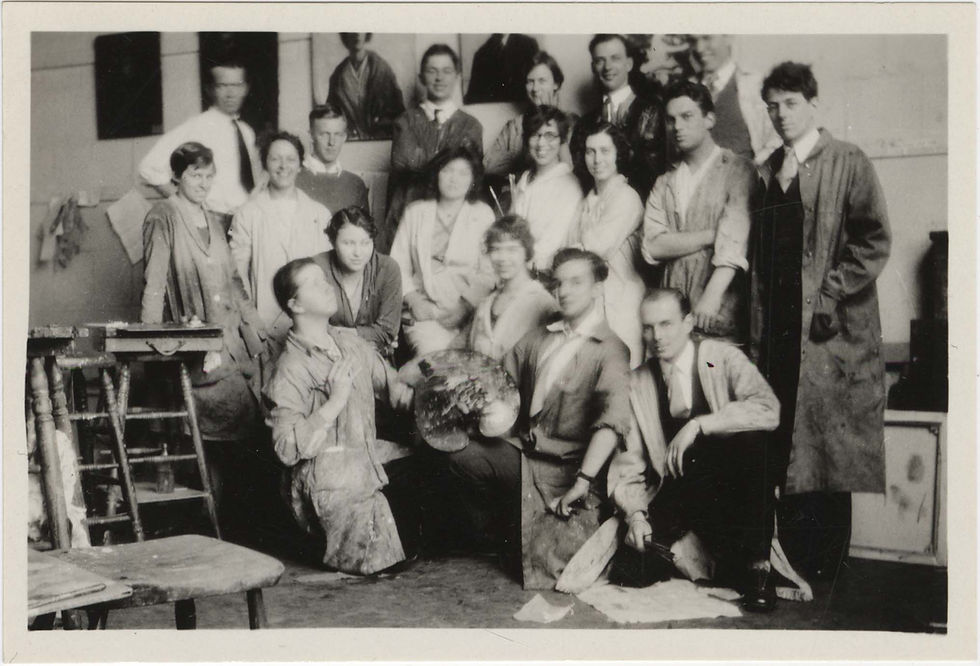
We started by gathering images and records relating to Catharine and Peter’s portraiture. I printed more than a hundred thumbnail images of portraits they painted throughout their lives, and Brittany sifted through thousands of records in our archives to find photographs from art school, diary entries and letters written by Catharine, notebooks and sketchbooks, and dozens of references to specific portrait sittings. We wanted to know Catharine and Peter on their own terms.
In Catharine’s case, this is easier because she was a prolific letter-writer and diarist. There are fewer written records from Peter, so much of what we know of him is filtered through Catharine’s perspective. What we learned from this research is that Catharine and Peter’s fondness for each other grew quickly and endured throughout their lives. We learned that Catharine understood and articulated her privilege, having grown up in a wealthy family, and that she wanted to embrace that privilege to become a great artist. In a diary entry written in 1926, she made a resolution: “I want to be a great artist.” She recognized that she had “every advantage,” that she could buy the best materials and go abroad, but she also understood that privilege did not automatically translate into discipline or achievement.

Catharine’s diaries also reveal the texture of student life. She admired her teachers and classmates, but despised anatomy assignments. She wrote with frustration and humour about portrait sitters’ restlessness, how they styled themselves, or in some cases how they fell asleep during sittings. She described the challenges of her studies, but also the camaraderie of fellow students working toward faithful depictions of their subjects. Sketching, drawing, and painting together became part of Catharine and Peter’s social life before it became their life’s work.

One diary entry from November 1927 describes an evening at Peter Whyte’s and Kendal Leece’s apartment. Catharine and her friends had “a beautiful time,” especially drawing Pete in his chaps, “which are beauties,” while also admiring his things. He produced ice cream and cake, “so it was quite a party.” In another entry, Catharine describes Sketch Club at her apartment as “such fun,” noting that they did not do a great deal of work because there were too many stories to tell. These details mattered to us. They made Catharine and Peter feel less like fixed historical figures and more like young artists trying to find their way, surrounded by friends, ambition, self-consciousness, and snacks.
Perspectives on Partnership, Friendship, and Community
The year 1925 at the School of the Museum of Fine Arts in Boston marks the beginning of their lifelong pursuit of learning, exploring, and making art together. Through their correspondence and Catharine’s diaries, we see a budding romance as well as the development of their early skills in painting and portraiture. Both describe how their ambition to become artists was intrinsically tied to their partnership and to the support they offered one another. In 1928, Peter wrote to Catharine that “it takes courage to say you are going to be an artist and then see it through.” He told her that her “encouragement helped him”, and that he “would help her all he could.”
After settling in Banff in 1930, Catharine and Peter continued to develop as artists. Their work reveals the lens through which they encountered the Bow Valley community, where they built their lives together. They often painted side by side, creating multiple pairs of paintings, one by Catharine and one by Peter. In some cases, the works are unsigned and undated, and we do not know which painting is Catharine’s and which is Peter’s. This uncertainty became interesting in itself. It suggested a kind of shared practice, a life in which artistic ambition, domestic partnership, and community engagement were deeply entwined.

Central to our aims was a desire to think deeply about the relationships between Catharine and Peter and the Stoney people. While these relationships have often been romanticized and simplified as those of “friends” or “supporters” of the Stoney community, we wanted to reflect more deeply on Catharine and Peter’s subject positions within a colonial system that repressed Indigenous communities across the country. We felt that careful reframing was important not only for developing this exhibition, but also for grappling with our present-day responsibilities in an art museum and archives founded by Catharine and Peter, which holds many invaluable records, photographs, portraits, and belongings from the Stoney people.

In October 1930, when Peter brought his new wife back to his hometown of Banff, they rented a rustic cabin for a week at the Morley train station and trading post on the Stoney Nakoda reserve. This allowed Catharine to meet and paint an important part of Peter’s social circle. Catharine had visited the Canadian Rockies only once before, in the summer of 1929, before relocating to Banff permanently in 1930. Her letters home note the novelty of her new surroundings: the vast foothills, sleeping on the ground, huddling by a woodstove with her new husband and travel companions.
Ethnographic portraiture was popular during this era, and one can see Catharine and Peter caught up in the excitement of painting subjects they may have perceived as more “exotic” than those they had encountered in art school. However, their portraits of Stoney men, women, and children cannot be reduced to this impulse alone. Several individuals seen in this exhibition held intimate roles in Peter’s life from childhood and remained connected to both Peter and Catharine throughout their lives.
The letters also describe unexpected sitters arriving wanting their portraits painted, having chosen specific clothing and accessories to wear. It was common in this era for artists and photographers to style Indigenous subjects in exaggerated costumes, removing the unique identifiers and specificity of the individual, resulting in romanticized images that would appeal to a broad market. It is notable that Catharine and Peter painted their subjects in their chosen attire, respecting their agency and individuality. That does not erase the colonial context, but it does complicate the story.
In early March, our Hosting Indigenous Community Relations team created an outreach event at the Bearspaw Youth Centre in Mînî Thnî. The goal was to share a collection of portraits being considered for the exhibition. We wanted to provide an opportunity for Stoney community members to view these works because it was likely that some of their ancestors were portrayed. In some cases where identities were unknown, we were hopeful that the sitters could be identified. Overarching all of this, the team wanted to create access and a sense of excitement around the celebration of these works.


This engagement shaped the exhibition in practical and meaningful ways. Wherever possible, we included full names in English, as well as Stoney, or Iêthka, language names with English translations. In one case, during the community engagement visit in Mînî Thnî, Nancy Abraham’s maiden name was confirmed by members of her family. These inclusions into portrait titles are part of The Whyte’s ongoing work to better restore specificity and acknowledge that these portraits continue to live within communities today.

One of the most moving groupings in the exhibition centres on David Bearspaw Sr. and his granddaughter Reba. In July 1933, Catharine wrote to her mother that the Bearspaw family came to have their portraits painted. David Bearspaw and his wife were, in her words, “a fine looking couple,” and they had “the dearest little granddaughter with them.” A few days later, she described the challenge of painting Reba, noting that the only way to keep her still was “to fascinate her by looking at her as hard as possible,” but that the fascination wore off all too quickly. This is such a vivid description of portraiture as a physical and relational exchange. It is also a reminder that behind every finished painting is a human encounter, sometimes patient, sometimes funny, sometimes imperfect.
Looking Again at Legacy
What happens when we lean into the familiar narratives, smooth out their edges, and languish in the glow of our founders’ larger-than-life reputations? What happens if we stop questioning the lore in favour of the manicured personae, affectionately sculpted by many years of telling and retelling? Would Catharine and Peter endorse such a rose-coloured tint? I don’t know.
But in my view, we do more justice to their memories when we allow their humanity and specificity into the frame. There is plenty to celebrate. Catharine and Peter spent their lives painting, building community, collecting, travelling, learning, and financially supporting worthy causes throughout the Bow Valley. They were important artists and community builders. They helped shape the cultural life of Banff not only through the works they made, but through the relationships, collections, archives, and institutions they left behind.
Our goal should not be to preserve a shrine to Catharine and Peter, but to carry on in their footsteps while being honest about the fullness of their lives. They were just two people trying to do right in the world. They succeeded and failed, were knocked down and got back up, and kept making. When our eyes touch was an opportunity to look again and to see their artwork and their humanity more clearly.
Experience the When our eyes touch Exhibition for Yourself
When our eyes touch invites visitors to look again at Catharine and Peter Whyte’s artwork, relationships, and legacy through the intimate act of portraiture. Plan your visit to experience the exhibition in person, take your time with the works, and consider what these portraits continue to reveal about art, community, and the stories we inherit.
Follow us on social for exhibition highlights, behind-the-scenes updates, and more stories from The Whyte’s collections and archives.
The museum is open daily from 10 a.m. to 5 p.m. at 111 Bear Street, Banff, AB.
Photo credits:
Image 1: Visitor viewing the feature wall of the When our eyes touch exhibition, on view at The Whyte from May to October 2026.
Image 2: Peter Whyte (1905 – 1966, Canadian). Untitled. 1928. charcoal on paper. 34.0 x 26.0 cm. Gift of Catharine Robb Whyte, O. C., Banff, 1975. WyP.03.006. Whyte Museum of the Canadian Rockies.
Image 3: Peter whyte. 1929 Painting class, 2nd year [Peter Whyte and Catharine Robb, second and third from left], 1929. Peter and Catharine Whyte fonds (V683/II/A/PA-686)
Image 4: Catharine's diary entry from 1926 while attending the School of the Museum of Fine Arts in Boston.
Image 5: Peter Whyte (1905 – 1966, Canadian). Untitled. 1927. conté on paper. 27.6 x 21.2 cm. Gift of Catharine Robb Whyte, O. C., Banff, 1979. WyP.03.838. Whyte Museum of the Canadian Rockies.
Image 6: Visitors taking in the When our eyes touch exhibition, on view at The Whyte from May to October 2026.
Image 7: Foothills from train at Morley, [ca. 1940], Nicholas Morant fonds (V500/I/A2/S-13)
Image 8: Outreach event at the Bearspaw Youth Centre in Mînî Thnî, facilitated by the Hosting Indigenous Community Relations team in March 2026.
Image 9: Outreach event at the Bearspaw Youth Centre in Mînî Thnî, facilitated by the Hosting Indigenous Community Relations team in March 2026.
Image 10: Catharine Robb Whyte, O. C. (1906 – 1979, Canadian). Reba Bearspaw. 1933. oil on canvas. 35.3 x 27.6 cm. Gift of Catharine Robb Whyte, O. C., Banff, 1979. WyC.01.410. Whyte Museum of the Canadian Rockies.


Comments