
Secrets and Scars in the Rockies: Banff National Park’s Internment Camps, 1915-1917
Updated: Feb 23
By Hannah Yuzwa, Processing Archivist
Today, millions of people come from all over the world to enjoy the wonders of Banff National Park. From the mountain peaks and the roaming wildlife to museums and National Historic Sites. Tourists spend millions of dollars every year to enjoy the place we call home.
Yet most travellers who pass through the Park gates never stop to think about the history around us.
Many of the destinations and attractions within Banff National Park hold dark histories. The scars of confinement and betrayal haunt many Ukrainian Canadians to this day.
Ukrainian History and Migration
Until 1991, Ukraine was under the colonial powers of the Austro-Hungarian and the Russian Empires. Ukrainians' sense of national identity, culture, and pride was seen as a threat to the Empire’s control. Ukrainian literature was banned. Artists and activists were imprisoned or exiled. Political repression and cultural assimilation of Ukrainians continued into the 20th century.
Many Ukrainians fled the persecution faced in their homeland. They saw Canada as a chance at freedom. The Canadian Government promised them citizenship and a better life. This allure of hope drew many Ukrainians to the Canadian West. They created community ties and transitioned into mainstream Canadian society. Many built schools and community centers. Loyal to their adopted home, Ukrainians worked hard to be accepted here in Canada. When their loyalty was betrayed during WWI, Ukrainians were traumatized and heartbroken.
The War Measures Act and “Enemy Aliens”
At the outbreak of WWI, widespread fear and distrust permeated the nation. This led the Canadian Government to enact the War Measures Act in August of 1914. The Act authorized the sweeping imprisonment and registration of people deemed "aliens of enemy nationality" (Government of Canada [Parliament] 1914). As citizens from the Austro-Hungarian Empire, Ukrainians were seen as “dangerous” to Canada and the Allies in the War. Under this law, many Ukrainians and other Eastern Europeans were labelled as “enemy aliens” and "threats" to Canada. As a result, thousands of people were detained simply because of where they came from.

Ukrainians across Canada were issued identity papers. They were obligated to report regularly to local authorities. Failure to comply meant arrest and detention to one of the internment camps. Upon an individual’s arrest, their valuables and assets were confiscated and turned over to the Canadian Government (Luciuk 2006; Ukrainian Canadian Civil Liberties Association). Economically, the toll of the internment camps on Ukrainian internees was devastating. Yet, it was the trauma experienced by these people and their families that cannot be forgotten.
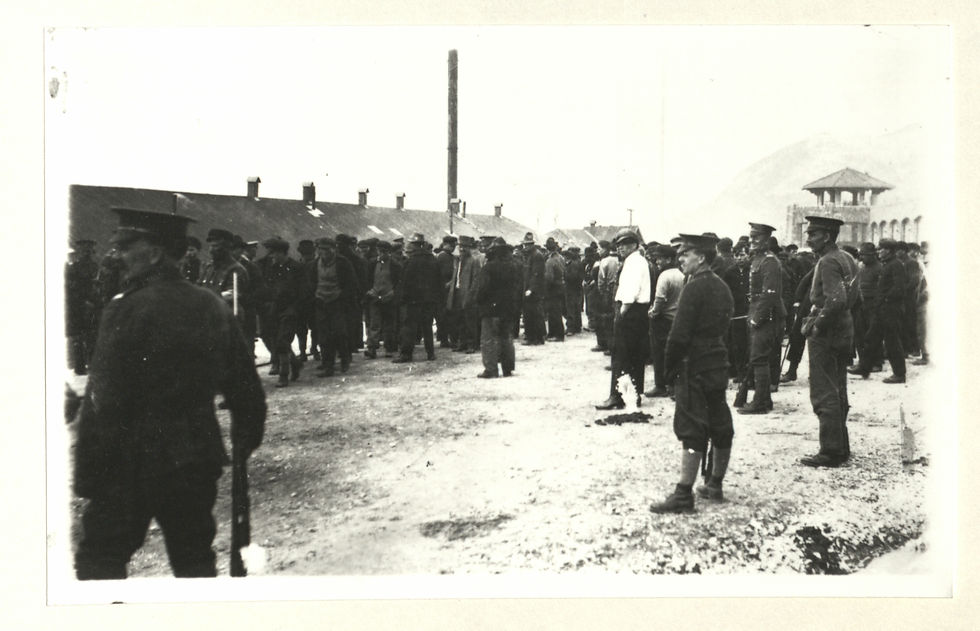
Banff National Park Internment Camps
From 1914 to 1920, there were 24 internment camps and receiving stations across Canada. Set up by the Department of National Defence, Canada’s First National Interment Operations incarcerated over 8,500 Ukrainians and Eastern Europeans. Just down the road, the Internment Camps at Castle Mountain and the Cave & Basin opened in 1915. These camps were the largest internment camps in the Rocky Mountains. Between 1915 and 1917, over 600 “enemy aliens” were sent to Castle Mountain (Conboy 2020; Ukrainian Canadian Civil Liberties Association). Under orders from the Department of National Defence and the Dominion Parks Branch, prisoners were sentenced to build the infrastructure and tourist sites that had once been just a dream for officials like J. B. Harkin.

As the Commissioner of the Dominion Parks Branch, Harkin believed that nature was integral to our health as individuals. Nature also influenced the country's health and economic prosperity. Harkin dreamed of a network of Canadian National Parks. Yet, the outbreak of WWI halted his plans. Insistent on his vision, he successfully lobbied the Canadian Government to ship “alien” internees to Banff, claiming it was for the betterment of the National Parks. For Harkin and the Government, internment operations were “good for business”. So, in July 1915, the gates of Castle Mountain Internment Camp were opened (Kordan 2016; Bella 1987).

The Castle camp was the first internment camp opened in the National Parks. Surrounded by barbed-wire fencing, Castle Mountain proved to be Harkin’s “ideal location” for the prisoners. Under threat from the guards, prisoners were ordered to construct the road between Banff and Lake Louise to capitalize on Harkin’s tourist agenda. The prisoners’ servitude built over six kilometres of the highway, paving the way for the future of the world-renowned Banff National Park as we know it (Waiser 1995; Ukrainian Canadian Civil Liberties Association).
Tourism being a pinnacle priority for Harkin, the internees were put to work on the development of the Banff Springs Hotel and Golf Course. In 1917, Harkin and the Canadian Pacific Railway reached an agreement to revitalize the Banff Springs into a post-war international tourist destination with world-class entertainment.
Hardships and Legacy
In one month, under the guards’ bayonets and rifles, the internees built an additional nine holes of the golf course. Their work included clearing trees for the fairway and reconstructing the Club House. Harkin’s dream became reality with the new Banff Springs Golf Course. As one of the best courses in the country, it was a destination for movie stars and royalty alike (Waiser 1995; Kordan and Melnycky 1991).

Future visitors to the National Park would enjoy the luxuries created by the prisoners. Yet, Banff and Castle Mountain became nightmares for the internees. If a prisoner was caught trying to escape, they were chained, hanged by their wrists, or shot by the camp guards. Beatings, starvation, and punishments of solitary confinement were common. The prisoners also had to contend with the natural elements of the Rockies (Farris). Internees were forced to work in conditions ranging from blazing heat to heavy snow, and even in winter temperatures below -40°C. At least one suicide and 60 escape attempts were recorded. Prisoners experienced despair, humiliation, and loss of hope. Some prisoners were taken to Calgary for psychological evaluations (Kordan and Melnycky 1991). Despite the horrors experienced by the prisoners, the camps continued to operate throughout the wartime.
![Figure 6: [untitled], 1914, The Whyte, Luxton family fonds, LUX / I / E4 / PA – 34](https://static.wixstatic.com/media/cd2968_271f08fce84a4fdeb0f6f576168b9955~mv2.jpg/v1/fill/w_980,h_1394,al_c,q_85,usm_0.66_1.00_0.01,enc_avif,quality_auto/cd2968_271f08fce84a4fdeb0f6f576168b9955~mv2.jpg)

The Cave & Basin and Castle Mountain Internment camps closed permanently on July 15th, 1917. The prisoners detained here were then shipped to other remaining camps, including out east to northern Ontario. The Kapuskasing Internment Camp was the last camp in Canada to close on February 24, 1920 (Kordan 2016; Ukrainian Canadian Civil Liberties Association). Over one year after the end of WWI, Canada’s First National Internment Operations shut down.

Yet for Ukrainian Canadians, the scars from the past will never be forgotten. With the dedication of the Ukrainian Canadian Civil Liberties Association (UCCLA), the statue and plaque titled ‘Why?’ now commemorate the injustices suffered by prisoners of the Castle Mountain Internment Camp. The UCCLA and the work of many individuals and scholars continue to educate the public about what occurred at the camps (Ukrainian Canadian Civil Liberties Association). In 2013, an internment camp exhibit opened at the Cave & Basin National Historic Site in Banff, Alberta. On October 28th, 2014, National Internment Commemoration and Education Day was designated in Canada. The Ukrainian community in Canada hopes to bring awareness to the events of the WWI internment camps and the importance of education in combating disinformation and missing perspectives from our past.
Cultural institutions play a crucial role in initiating meaningful conversations about the events of the past. As you wander through our Heritage Gallery, visitors will notice yellow labels that have been added to the Gallery’s text panels. These Truth-Telling Interventions are meant to encourage visitors to engage more thoughtfully with the history presented to them. No matter how uncomfortable it is, it is important to recognize how the past has impacted individuals and cultures within our community. Here at The Whyte, we believe in fostering a safe environment to respectfully engage with important topics in this area, while still approaching these conversations with dignity and integrity for the communities affected by those experiences. It is important to create spaces for open and honest discussions and to learn about each other’s perspectives. Through these conversations, there is hope that we may create a more inclusive, diverse, compassionate and understanding path for our future.
Interested in learning more about Canadian Rockies history?
Plan your visit online and visit us in person to explore The Whyte’s Truth-Telling Interventions in our Heritage Gallery and the Archives Reading Room. Learn more about the history of Banff National Park and the Internment Camps by visiting our online database.
The museum is open daily from 10 a.m. to 5 p.m. at 111 Bear Street, Banff, AB
Sources
Bella, Leslie
1987 Parks for Profit. Montreal. Harvest House Ltd.
Conboy, Marie
2020 Remembering the 600 internees of Castle Mountain Internment Camp In The Crag &
Canyon. Accessed July 29, 2025 https://www.thecragandcanyon.ca/news/local-news/remembering-the-600-internees-of-castle-mountain-internment-camp
Farris, Andrew
Canadian Dream to Canadian Nightmare: First World War Internment in Banff. In On This
Spot. Accessed April 14, 2025 https://onthisspot.ca/cities/banff/caveandbasin
Government of Canada (Parliament)
1914 An Act to confer certain powers upon the Governor in Council and to amend the
Immigration Act, SC, 1914, c 2 (The War Measures Act). Accessed September 17, 2025
Kordan, Bohdan
2016 No Free Man: Canada, the Great War, and the Enemy Alien Experience. Montreal &
Kingston: McGill-Queen's University Press.
Kordan, Bohdan S. and Peter Melnycky, eds.
1991 In the Shadow of the Rockies Diary of the Castle Mountain Internment Camp
1915-1917. Edmonton: Canadian Institute of Ukrainian Press The University of Alberta.
Luciuk, Lubomyr
2006 Without Just Cause: Canada’s first national internment operations and the Ukrainian
Canadians, 1914-1920. The Kashtan Press.
Ukrainian Canadian Civil Liberties Association
Canada’s First National Internment Operations of 1914-1920. Accessed July 9, 2025
Waiser, Bill
1995 Park Prisoners: The Untold Story of Western Canada’s National Parks, 1915-1946.
Saskatoon: Fifth House Ltd.
Figures:
Figure 1: Castle Mtn. Camp. Shewing Storm Mtn taken from Castle Mtn, ca. 1915-1917, The Whyte, William D. Buck fonds, V295/LC/PD/20 accn. 666
Figure 2: Prisoners. Going into Compound., ca. 1915-1917, The Whyte, William D. Buck fonds, V295/LC/PD/45 accn. 6666
Figure 3: Documents, 1973, The Whyte, James Anderson-Wilson fonds, V20/PA 228
Figure 4: Prisoners’ Leaving Banff for Castle Mtn, ca.1915-1917, The Whyte, William D. Buck fonds, V295/LC/PD/19 accn. 6666
Figure 5: Prisoner. on stretcher. Shot by Guard when trying to escape., ca. 1915-1917, The Whyte, William D. Buck fonds, V295/LC/PD/55 accn. 6666
Figure 6: [untitled], 1914, The Whyte, Luxton family fonds, LUX / I / E4 / PA – 34
Figure 7: Coffin passing the Compound., ca. 1915-1917, The Whyte, William D. Buck fonds, V295/LC/PD/99 accn. 6666
Figure 8: & taking them to northern Ontario, ca. 1915-1917, The Whyte, William D. Buck fonds, V295/LC/PD/90 accn. 6666


Comments